- kojimako17小时前
订阅老版 Kimi 会员计划的 Allegro(699 元/月)套餐已有数月,日常高强度用下来一直对套餐内部的实际扣费规则比较好奇,恰逢近期 K3.1 系列上线,索性做了一轮定量实测,把 Code 额度下 6 个模型的计费方程、之前大家讨论好久的 K3 256K 阈值规则、折算官方 API 的回本价值以及各模型吞吐算了一遍,分享给佬友们一同探讨。需要说明的是,该套餐实际还包含月度总额度,但受限于无法通过 API 获取读数,且会与 Chat / Work 模式混合计费,因此本文仅讨论 Code 额度(
5h/7d窗口),不讨论月度总额度及 Chat / Work 模式的计费制度。叠甲声明:本文所有数据均基于单个老版 Allegro 账号在 2026 年 10 月 24–25 日的黑盒实测反推,仅代表测试当下的账户状态。正如测试期间 K3.1 系列权重在一天内就下调了 35%,官方后台随时可能动态调整计费系数与档位策略;文中的 API 折算金额与吞吐数据高度依赖具体使用场景及测试时段负载,仅供佬友们技术交流参考。实验脚本编写、数据拟合与图表绘制由 Gemini 4 Argon 与 Claude Opus 5.5 辅助完成,如有疏漏欢迎指正。
TL;DR
本文基于 2026 年 10 月 24 日早上与 10 月 25 日凌晨的两轮实测(文中时间均为 UTC+8),以老版 Kimi Allegro 套餐为样本,利用配额接口
GET /coding/v1/usages中保留 4 位小数的used_ratio字段,通过控制变量实验反推出完整的计费方程与吞吐表现。核心结论如下:-
7d/5h额度呈现 5 倍关系:套餐 7 天(7d)限额封顶为 5 个 5 小时(5h)限额。- 套餐内缓存读取极便宜、输出权重偏高:各模型缓存读取权重均约为未命中输入的 \frac{1}{200} (远低于国内站 API 的 \frac{1}{10} ),且无缓存写入溢价;K3 / K3.1 系列输出权重约为未命中输入的 8\times ,K2 系列为 10\times ,均高于国内站 API 的 4.2 \sim 5.2\times 。两个高速版分别为对应标准版的三项同步放大,而国内站 API 上高速版的缓存读取并不加价。
- K3.1 系列权重在两次测试间下调了 35%,消除了与
K3的倒挂但相对比例仍高于 API 价格比:国内站按量 API 上K3.1 Pro定价约为K3的 0.65 \sim 0.68\times ;10 月 24 日首轮实测时套餐内K3.1 Pro权重反而是K3的 1.31\times ,10 月 25 日凌晨复测时K3.1 Pro与K3.1 Pro Highspeed三项权重同步下调至首轮的 0.65\times (即K3的约 0.85\times ,仍高于两者在按量 API 上的 0.65 \sim 0.68\times 价格比),其余模型权重不变。-
K3/K3-256k在实际总长 T_{\text{prompt}} + T_{\text{out}} > 256\text{K} 时整段输出按 2\times 计费:两者共享同一 KV Cache 池,计费权重完全相同;当输入加输出的实际总长超过 256\text{K} (而非按max_tokens声明上限计算)时,输入与缓存读取权重不变,整段输出按 2\times 计费。两者的唯一区别是仅当 T_{\text{prompt}} > 256\text{K} 时K3-256k会返回 400 报错。- Allegro 套餐折算国内站 API 的人民币等效价值:以典型长文编码场景(缓存命中率 h = 97.5\% 、未命中输入/输出比 r = 2.5 )为基准,按 10 月 25 日复测权重,
K3.1 Pro单次5h满额度等效国内站 API 220.4\text{ 元} ,单周7d满额度等效 1,102.0\text{ 元} (首轮权重下为 143.0 / 715.0\text{ 元} );同场景下K3(总长 \le 256\text{K} )单周7d满额度等效 1,423.1\text{ 元} 。- 各模型流式吞吐(TTFT 与 TPS)实测排序: 51.2\text{K} 未缓存预填充阶段 K3.1 系列最快(比 K2 与 K3 快约一倍);长输出持续吞吐率从高到低依次为
K2.7 Code Highspeed>K3.1 Pro Highspeed>K2.8 Preview>K3.1 Pro>K3( \le 256\text{K} ) >K3-256k>K3( > 256\text{K} )。1. 测试接口与权重反推方法
通过调用 Kimi 的配额接口
GET https://api.kimi.com/coding/v1/usages可获取当前账户的额度状态, JSON 返回体中.usages.limit_5h.used_ratio与.usages.limit_7d.used_ratio提供了保留 4 位小数的已用比例。单次请求的配额消耗由
usage返回的三项 Token 决定:- 未命中输入 T_{\text{in}} (
prompt_tokens - cached_tokens):未命中历史缓存的前缀部分(含末尾凑不够一整块缓存块 B 的零头)以及本轮新增输入,必须重新做 Prefill 计算,统一按未命中输入计费;- 缓存读取 T_{\text{cr}} (
cached_tokens):实测返回的 T_{\text{cr}} 恒为固定块大小 B = 256 Token 的整数倍,只有完整命中的块才计入缓存读取,末尾不足 256 Token 的零头归入 T_{\text{in}} ;- 总输出 T_{\text{out}} (
completion_tokens):包含思考链(reasoning_tokens)与最终回复正文,统一按输出计费。记某模型在
5h或7d窗口下每百万 Token( \text{M} )的三项扣费权重为 (w_{\text{in}}, w_{\text{cr}}, w_{\text{out}}) ,第 k 次请求后的累计百万 Token 数为 (S_{\text{in},k}, S_{\text{cr},k}, S_{\text{out},k}) 。由于接口返回的读数 y_k 是四舍五入到 4 位小数的,未四舍五入的真实累计消耗 y_k^* 与读数 y_k 的误差不超过半个最小步长 \delta = 0.5 \times 10^{-4} :y_k^ = x_0 + w_{\text{in}} S_{\text{in},k} + w_{\text{cr}} S_{\text{cr},k} + w_{\text{out}} S_{\text{out},k}, \qquad \left| y_k^ - y_k \right| \le \delta = 0.5 \times 10^{-4}
其中 x_0 为初始真实已用比例,单步增量 \Delta y_j = y_j - y_{j-1} 的最大舍入误差为 2\delta = 0.00010 。通过将多轮控制变量请求的累计 Token 数与读数代入线性规划,即可直接解出三项权重的中心解及严格可行区间 [w_{q,\min}, w_{q,\max}] 。
2.
K3.1 Pro权重实测与 256-Token 缓存块对齐2.1 六组控制变量实验与 B = 256 缓存块边界
对
K3.1 Pro依次针对三个计费维度做控制变量调用(共 40 次调用、41 组usage读数,轨迹见图 1):先通过随机长文与短输入长输出分别测出 w_{\text{in}} 与 w_{\text{out}} ,并验证首次写入长前缀无额外溢价;针对权重极小的缓存读取 w_{\text{cr}} ,为避免末尾不足 256 Token 的未对齐零头混入 T_{\text{in}} 干扰测量,用单 Token 词" apple"将系统提示词对齐到 256 的整数倍( 51.2\text{K} / 100.1\text{K} ),使每轮新增未命中输入固定为 16 Token。将全部读数代入线性规划,求得中心解为 (0.143997, 0.000760, 1.155950)\,\text{M}^{-1} ,表 1 取整为 (0.14400, 0.000750, 1.15600)\,\text{M}^{-1} ,代回检验全部读数最大残差仅 0.48\times 10^{-4} < \delta 。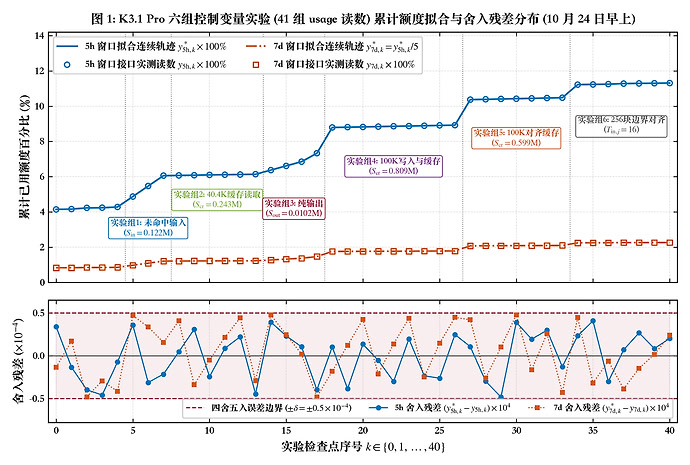
2.2
K3.1 Pro首轮计费方程与国内站 API 定价对比由拟合结果可得
K3.1 Pro在5h与7d窗口的累计额度消耗方程:\boxed{\Delta y_{5\text{h},k}^ = 0.14400\,S_{\text{in},k} + 0.000750\,S_{\text{cr},k} + 1.15600\,S_{\text{out},k}, \qquad \Delta y_{7\text{d},k}^ = \frac{1}{5}\,\Delta y_{5\text{h},k}^*}
其中接口读数 y_k = \operatorname{round}(x_0 + \Delta y_k^*, 4) 。基于上述公式,
K3.1 Pro的套餐权重与国内站开放平台(platform.moonshot.cn)官方定价对比见表 1。表 1:
K3.1 Pro在老版 Allegro 套餐中的拟合权重与国内站 API 定价对比表(10 月 24 日首轮)计费项 |
5h 窗口可行区间 ( \text{M}^{-1} ) |
5h 窗口权重 w_{q,5\text{h}} ( \text{M}^{-1} ) |
7d 窗口权重 w_{q,7\text{d}} ( \text{M}^{-1} ) |
5h / 7d 满额纯输入或纯输出 |
国内站 API 单价 P_q ( \text{元/M} ) |
套餐内部相对权重比 vs 国内站 API 相对价格比 |未命中输入 ( \text{in} ) |
[0.143850, 0.144171] |
0.14400 ( 14.40\% ) |
0.02880 ( 2.88\% ) |
6.94\text{M} / 34.72\text{M} |
13.00\text{ 元} |
1.000 vs 1.000 |缓存读取 ( \text{cr} ) |
[0.000703, 0.000792] |
0.000750 ( 0.075\% ) |
0.000150 ( 0.015\% ) |
1,333.3\text{M} / 6,666.7\text{M} |
1.30\text{ 元} |
约 0.00521 ( \frac{1}{192} ) vs 0.1000 ( \frac{1}{10} ) |首次缓存写入溢价 |
未单独计费(归入 \text{in} ) |
0.00000 |
0.00000 |
按普通未命中输入计费 |
13.00\text{ 元}(5\text{分钟}) / 26.00\text{ 元}(1\text{小时}) |
无写入溢价 |模型输出 ( \text{out} ) |
[1.155080, 1.158198] |
1.15600 ( 115.60\% ) |
0.23120 ( 23.12\% ) |
0.865\text{M} / 4.325\text{M} |
68.00\text{ 元} |
8.028\times vs 5.231\times |2.3
K3.1 Pro复测(10 月 25 日凌晨)10 月 25 日凌晨对
K3.1 Pro重新做了 44 次调用(覆盖 41\text{K} \sim 128\text{K} 未命中输入、256-Token 对齐缓存命中与 2\text{K} \sim 4\text{K} 长输出),不同长度下拟合出的权重完全一致。复测与首轮的对比见表 1b:表 1b:
K3.1 Pro两轮实测5h窗口权重对比( \text{M}^{-1} )计费项 |
首轮(10 月 24 日早上) |
复测可行区间(10 月 25 日凌晨) |
复测取整值 |
复测 / 首轮 |
复测 /K3|未命中输入 w_{\text{in}} |
0.14400 |
[0.09349, 0.09396] |
0.0936 |
0.650 |
0.851 |缓存读取 w_{\text{cr}} |
0.000750 |
[0.000466, 0.000480] |
0.000473 |
0.63 |
0.862 |输出 w_{\text{out}} |
1.15600 |
[0.7488, 0.7538] |
0.751 |
0.650 |
0.850 |复测取整值 (0.0936, 0.000473, 0.751) 在
5h与7d两个窗口下均吻合,内部比例为 1 : \frac{1}{198} : 8.02 ,与首轮基本相同,即三项按同一比例下调。K3.1 Pro Highspeed同期复测(31 次)为 (0.1872, 0.000946, 1.502)\,\text{M}^{-1} ,依然为标准版的 2\times 。复测时K3.1 Pro的扣费权重降至K3的约 0.85\times ,消除了首轮的价格倒挂,但相对K3的比例仍高于两者在国内站 API 上的 0.65 \sim 0.68\times 价格比。3. 全模型计费权重与
K3的 256K 阈值测试3.1 其余模型测试与
K3256K 阈值控制变量实验沿用相同的控制变量方法测出其余 5 个模型的权重(汇总见 3.2 节表 2),并重点验证了跨模型缓存互通性与
K3/K3-256k的 256K 阈值规则:- 跨模型缓存互通性与同价关系:标准版与高速版之间、不同代模型之间切换时
cached_tokens均为 0 (缓存池相互独立);唯独K3与K3-256k共享同一缓存池(在K3-256k预热的 256\text{K} 前缀切到K3可直接 100% 命中),且两者的三项计费权重完全相同。-
K3/K3-256k的 256K 阈值规则:在 253\text{K} \sim 333\text{K} 区间通过前缀缓存复用做了跨阈值对照测试(图 2(b))。实测超过阈值后未命中输入与缓存读取权重不变,仅输出权重 w_{\text{out}} 翻倍( 2\times );且一旦越过阈值,整段输出均按 2\times 计费。进一步将总长收窄至 255.3\text{K} \sim 256.2\text{K} ,确认触发条件为实际总长 T_{\text{prompt}} + T_{\text{out}} > 256\text{K} 。按实际总长 > 256\text{K} 分段后,
K3与K3-256k的三项权重可行区间分别为 w_{\text{in}} \in [0.10998, 0.11001] 、 w_{\text{cr}} \in [0.000549, 0.000551] 、 w_{\text{out}} \in [0.88311, 0.88386]\,\text{M}^{-1} ,取整后为:\left(w_{\text{in},5\text{h}}^{(\texttt{K3})},\; w_{\text{cr},5\text{h}}^{(\texttt{K3})},\; w_{\text{out},5\text{h}}^{(\texttt{K3})}\right) = \begin{cases}
(0.1100,\; 0.000549,\; 0.8836)\,\text{M}^{-1}, & \text{若 } T_{\text{prompt}} + T_{\text{out}} \le 256\text{K} \\
(0.1100,\; 0.000549,\; 1.7672)\,\text{M}^{-1}, & \text{若 } T_{\text{prompt}} + T_{\text{out}} > 256\text{K}
\end{cases}K3与K3-256k的唯一区别是:仅当 T_{\text{prompt}} > 256\text{K} 时K3-256k返回 400 报错;若 T_{\text{prompt}} < 256\text{K} 而加上输出后实际总长超过 256\text{K} ,K3-256k同样正常返回并按 2\times 计费。3.2 全模型计费权重总表与对比
汇总当前订阅内全部 6 个模型的拟合权重、满额容量及国内站 API 定价见表 2 与图 2。
表 2 权重单位均为 \text{M}^{-1} ,
7d权重为5h的 \frac{1}{5} 。K3.1 系列在两次测试间调整过权重,表中分别列出 10 月 24 日与 10 月 25 日两次测试的结果,其余模型两轮一致。表 2:老版 Allegro 套餐全模型计费权重、满额容量与国内站 API 定价总表
模型名称 |
分段条件 |
w_{\text{in},5\text{h}} |
w_{\text{cr},5\text{h}} |
w_{\text{out},5\text{h}} |
w_{\text{in},7\text{d}} |
w_{\text{cr},7\text{d}} |
w_{\text{out},7\text{d}} |
5h 满额纯输入 / 纯输出 |
内部比例 w_{\text{in}} : w_{\text{cr}} : w_{\text{out}} |
国内站 API 入/缓/出 ( \text{元/M} ) |
相对K3(总长 \le 256\text{K} )倍率 |K2.7 Code Highspeed|
— |
0.2000 |
0.001000 |
2.0000 |
0.04000 |
0.000200 |
0.40000 |
5.00\text{M} / 0.500\text{M} |
1 : \frac{1}{200} : 10.00 |
13.70 / 2.74 / 57.60 |
1.818 / 1.821 / 2.263\times (K2.8的 3\times ) |K2.8 Preview|
— |
\frac{1}{15} ( 0.06667 ) |
\frac{1}{3000} ( 0.000333 ) |
\frac{2}{3} ( 0.66667 ) |
\frac{1}{75} |
\frac{1}{15000} |
\frac{2}{15} |
15.00\text{M} / 1.500\text{M} |
1 : \frac{1}{200} : 10.00 |
6.80 / 1.36 / 28.80 |
0.606 / 0.607 / 0.754\times |K3/K3-256k|
T_{\text{prompt}} + T_{\text{out}} \le 256\text{K} |
0.1100 |
0.000549 |
0.8836 |
0.02200 |
0.000110 |
0.17672 |
9.09\text{M} / 1.132\text{M} |
1 : \frac{1}{200} : 8.03 |
20.00 / 2.00 / 100.00 |
1.000\times (基准) |K3/K3-256k|
T_{\text{prompt}} + T_{\text{out}} > 256\text{K} |
0.1100 |
0.000549 |
1.7672 |
0.02200 |
0.000110 |
0.35344 |
9.09\text{M} / 0.566\text{M} |
1 : \frac{1}{200} : 16.07 |
20.00 / 2.00 / 100.00 |
入/缓 1\times ,出 2\times |K3.1 Pro(10 月 24 日测试) |
— |
0.14400 |
0.000750 |
1.15600 |
0.02880 |
0.000150 |
0.23120 |
6.94\text{M} / 0.865\text{M} |
1 : \frac{1}{192} : 8.03 |
13.00 / 1.30 / 68.00 |
1.309 / 1.366 / 1.308\times |K3.1 Pro(10 月 25 日测试) |
— |
0.0936 |
0.000473 |
0.751 |
0.01872 |
0.0000946 |
0.1502 |
10.68\text{M} / 1.332\text{M} |
1 : \frac{1}{198} : 8.02 |
13.00 / 1.30 / 68.00 |
0.851 / 0.862 / 0.850\times |K3.1 Pro Highspeed(10 月 24 日测试) |
— |
0.28800 |
0.001500 |
2.31200 |
0.05760 |
0.000300 |
0.46240 |
3.47\text{M} / 0.433\text{M} |
1 : \frac{1}{192} : 8.03 |
26.00 / 1.30 / 136.00 |
2.62\times (K3.1 Pro的 2\times ) |K3.1 Pro Highspeed(10 月 25 日测试) |
— |
0.1872 |
0.000946 |
1.502 |
0.03744 |
0.000189 |
0.3004 |
5.34\text{M} / 0.666\text{M} |
1 : \frac{1}{198} : 8.02 |
26.00 / 1.30 / 136.00 |
1.70\times (K3.1 Pro的 2\times ) |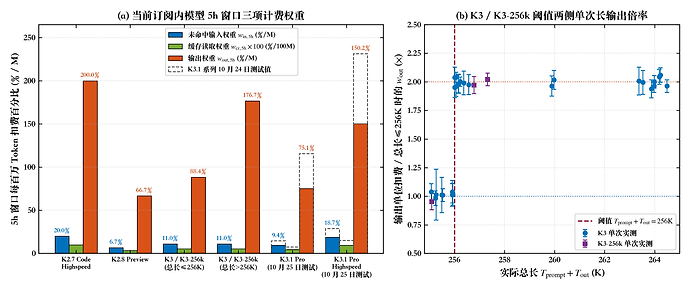
表 2 中值得注意的几处细节:
-
K3与K3.1 Pro的套餐/API 价格关系:国内站按量 API 上,K3.1 Pro( 13 / 1.3 / 68\text{ 元/M} )约为K3( 20 / 2 / 100\text{ 元/M} )的 0.65 \sim 0.68\times 。10 月 24 日首轮实测时,套餐内K3.1 Pro的扣费权重是K3的 1.31\times ,存在倒挂;10 月 25 日凌晨复测时下调为K3的约 0.85\times ,但相对比例仍高于两者在按量 API 上的价格比。- 缓存读取统一约为未命中输入的 1/200:
K2.8 Preview的 w_{\text{cr}} 可行区间为 [0.000328, 0.000342]\,\text{M}^{-1} ,与 \frac{1}{3000} 吻合;K3为 w_{\text{in}} / 200.4 ,K3.1 Pro为 w_{\text{in}} / 198 。两代模型的差别在输出倍率:K2 系列为 10\times ,K3 / K3.1 系列约为 8.0\times 。- 高速版为标准版的固定倍数:
K3.1 Pro Highspeed为K3.1 Pro的 2\times ,K2.7 Code Highspeed为K2.8 Preview的 3\times ,三项同步放大。国内站 API 上高速版的缓存读取不加价,套餐内则与输入、输出同步放大。4. 套餐额度折算国内站 API 的人民币价值
由于套餐内部的三项权重比例与国内站按量 API 的单价比例不同,满额度能折合多少按量 API 费用,取决于日常使用时的上下文缓存命中率 h = \frac{T_{\text{cr}}}{T_{\text{in}} + T_{\text{cr}}} 与未命中输入/输出比 r = \frac{T_{\text{in}}}{T_{\text{out}}} 。
设某模型在国内站 API 的单价为 (P_{\text{in}}, P_{\text{cr}}, P_{\text{out}}) (单位: \text{元/M} ),其在
5h窗口的权重为 (w_{\text{in},5\text{h}}, w_{\text{cr},5\text{h}}, w_{\text{out},5\text{h}}) ,则单次5h满额度下的最大输出量 S_{\text{out},5\text{h}}^{\max} 及5h、7d满额度折算的国内站 API 人民币金额 V_{5\text{h}}, V_{7\text{d}} 为:S_{\text{out},5\text{h}}^{\max}(r, h) = \frac{1}{w_{\text{in},5\text{h}} \cdot r + w_{\text{cr},5\text{h}} \cdot r \frac{h}{1-h} + w_{\text{out},5\text{h}}}
V_{5\text{h}}(r, h) = \frac{P_{\text{in}} \cdot r + P_{\text{cr}} \cdot r \frac{h}{1-h} + P_{\text{out}}}{w_{\text{in},5\text{h}} \cdot r + w_{\text{cr},5\text{h}} \cdot r \frac{h}{1-h} + w_{\text{out},5\text{h}}}, \qquad V_{7\text{d}}(r, h) = 5\,V_{5\text{h}}(r, h)
以下统一按参考工况估算:长文编码场景,缓存命中率 h = 97.5\% 、未命中输入 : 输出 r = 2.5 。代入表 2 的权重,各模型折算结果见表 3 与图 3。K3.1 系列在两次测试间调整过权重,表中分别列出两次测试的结果,其余模型两次测试一致。
表 3:参考工况( h = 97.5\% 、 r = 2.5 )下各模型满额度的国内站 API 人民币等效价值
模型 |
5h 满额度可用输出 ( S_{\text{out},5\text{h}}^{\max} ) |
5h 满额度等效 ( V_{5\text{h}} ) |
7d 满额度等效 ( V_{7\text{d}} ) |
每 1\% 5h 配额折合 |K2.7 Code Highspeed|
385.0\text{K} |
138.2\text{ 元} |
691.0\text{ 元} |
1.38\text{ 元} |K2.8 Preview|
1{,}155.0\text{K} |
206.0\text{ 元} |
1{,}030.2\text{ 元} |
2.06\text{ 元} |K3/K3-256k(总长 \le 256\text{K} ) |
825.0\text{K} |
284.6\text{ 元} |
1{,}423.1\text{ 元} |
2.85\text{ 元} |K3/K3-256k(总长 > 256\text{K} ) |
477.2\text{K} |
164.6\text{ 元} |
823.1\text{ 元} |
1.65\text{ 元} |K3.1 Pro(10 月 24 日测试) |
629.3\text{K} |
143.0\text{ 元} |
715.0\text{ 元} |
1.43\text{ 元} |K3.1 Pro(10 月 25 日测试) |
969.8\text{K} |
220.4\text{ 元} |
1{,}102.0\text{ 元} |
2.20\text{ 元} |K3.1 Pro Highspeed(10 月 24 日测试) |
314.6\text{K} |
103.1\text{ 元} |
515.6\text{ 元} |
1.03\text{ 元} |K3.1 Pro Highspeed(10 月 25 日测试) |
484.9\text{K} |
158.9\text{ 元} |
794.6\text{ 元} |
1.59\text{ 元} |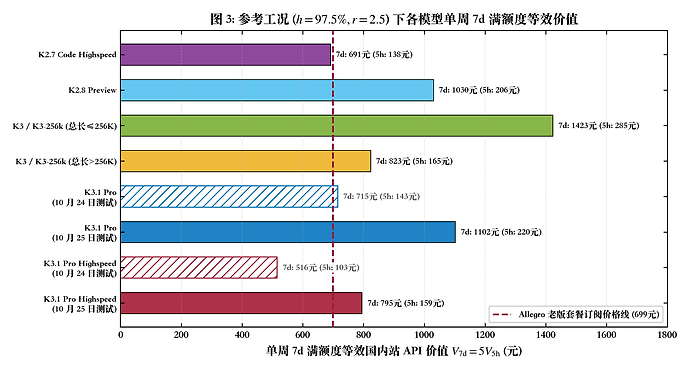
在参考工况下,
K3.1 Pro按复测权重单周7d满额度即折合官方 API 1{,}102.0\text{ 元} (首轮权重下为 715.0\text{ 元} ),单周额度已超过 699 元月费。K3(总长 \le 256\text{K} )的等效价值最高,达 1{,}423.1\text{ 元} ,原因是K3的国内站 API 单价是K3.1 Pro的 1.47 \sim 1.54\times ,而套餐扣费权重只高 1.17\times 。5. 流式输出吞吐与首 Token 延迟(TPS / TTFT)实测
在测试计费权重的同时,也在 SSE 流式请求中记录了请求发出、首包到达、末包到达与流结束时刻,测出各模型在不同上下文长度下的首 Token 延迟 \text{TTFT} 、长输出持续解码速率 \text{TPS}_{\text{dec}} (扣除 \text{TTFT} ,取 1.5\text{K} \sim 2\text{K} 长输出样本)及端到端速率 \text{TPS}_{\text{E2E}} ,实测均值及范围见表 4。
注:表 4 数据测于 10 月 24 日早上 6:10–6:32,仅代表该时段 Kimi 计算集群的负载状态,TPS 仅作参考,具体仍受限于实际输出内容分布。每个模型的长输出样本仅 n = 2 ,部分模型两次差异较大(如
K2.8 Preview为 51.0 / 135.3\,\text{tok/s} ),排序仅供参考;K3-256k第 2 次长输出提前结束(仅 412 Token),但仍计入了均值。表 4:10 月 24 日早上实测订阅内模型客户端流式输出吞吐率 ( \text{TPS}_{\text{dec}}, \text{TPS}_{\text{E2E}} ) 与多档位首 Token 延迟 ( \text{TTFT} ) 实测表
模型名称 |
短输入 \text{TTFT} ( \sim 100\,\text{tok} ) |
51.2\text{K} 未缓存预填充 \text{TTFT} (按 T_{\text{prompt}} / \text{TTFT} 折算输入速率) |
51.2\text{K} 缓存命中 \text{TTFT} |
256\text{K} \sim 333\text{K} 缓存命中 \text{TTFT} |
长输出持续吞吐率 \text{TPS}_{\text{dec}} ( 1.5\text{K} \sim 2\text{K} ) |
长输出端到端速率 \text{TPS}_{\text{E2E}} |K2.7 Code Highspeed|
0.91\,\text{s} ( 0.83\sim 0.98\,\text{s} ) |
10.42\,\text{s} ( \sim 4.9\text{K/s} ) |
1.63\,\text{s} ( 1.48\sim 1.73\,\text{s} ) |
(上限 256K) |
230.0\,\text{tok/s} ( 186.8\sim 273.3 ) |
208.6\,\text{tok/s} |K2.8 Preview|
0.62\,\text{s} ( 0.60\sim 0.63\,\text{s} ) |
6.50\,\text{s} ( \sim 7.9\text{K/s} ) |
2.51\,\text{s} (中位 1.20\,\text{s} ) |
— |
93.2\,\text{tok/s} ( 51.0\sim 135.3 ) |
90.1\,\text{tok/s} |K3( \le 256\text{K} ) |
1.41\,\text{s} ( 0.98\sim 1.84\,\text{s} ) |
7.71\,\text{s} ( \sim 6.6\text{K/s} ) |
4.95\,\text{s} ( 1.50\sim 10.44\,\text{s} ) |
16.33\,\text{s} ( @256\text{K} ) |
61.9\,\text{tok/s} ( 59.7\sim 64.0 ) |
59.4\,\text{tok/s} |K3-256k|
1.86\,\text{s} ( 1.00\sim 2.72\,\text{s} ) |
6.30\,\text{s} ( \sim 8.1\text{K/s} ) |
5.44\,\text{s} ( 3.52\sim 9.37\,\text{s} ) |
18.64\,\text{s} ( @256\text{K} ) |
51.7\,\text{tok/s} ( 51.5\sim 51.9 ) |
44.5\,\text{tok/s} |K3( > 256\text{K} @333\text{K} ) |
— |
21.73\,\text{s} ( 271\text{K} 未缓存, 12.5\text{K/s} ) |
— |
20.85\,\text{s} ( @333\text{K} ) |
44.3\,\text{tok/s} ( 37.2\sim 51.3 ) |
29.8\,\text{tok/s} |K3.1 Pro|
1.22\,\text{s} ( 0.95\sim 1.49\,\text{s} ) |
3.14\,\text{s} ( \sim 16.3\text{K/s} ) |
2.22\,\text{s} ( 1.54\sim 2.89\,\text{s} ) |
— |
68.7\,\text{tok/s} ( 67.5\sim 69.9 ) |
65.0\,\text{tok/s} |K3.1 Pro Highspeed|
0.80\,\text{s} ( 0.77\sim 0.83\,\text{s} ) |
3.17\,\text{s} ( \sim 16.2\text{K/s} ) |
1.39\,\text{s} ( 1.18\sim 1.72\,\text{s} ) |
— |
124.6\,\text{tok/s} ( 120.7\sim 128.5 ) |
116.7\,\text{tok/s} |表 4 中最值得关注的是预填充与缓存命中 \text{TTFT} 的反转现象:在 51.2\text{K} 未缓存预填充时,
K3.1 Pro比K2.8 Preview快一倍以上( 3.14\,\text{s} vs 6.50\,\text{s} );但同样长度一旦命中缓存,K3 / K3.1 的首包响应(K3.1 Pro2.22\,\text{s} 、K34.95\,\text{s} )反而比 K2(中位 1.20\,\text{s} )更慢。附录
附带了Argon写的小脚本,供大家参考。
附录 A:快速测算脚本(
kimi_plan_quick_probe.py)功能说明:耗时约 40\,\text{s} ,发送 4 次校准请求(消耗约 1.0\% \sim 1.5\%
5h配额),测算当前账户相对于老版 Allegro(699 元)套餐的配额容量缩放倍率,并输出当前订阅内模型可用 Token 上限、参考工况国内站 API 等效人民币价值及实测 \text{TTFT} 、 \text{TPS}_{\text{dec}} 。基准权重采用 10 月 25 日凌晨复测值,默认以K2.8 Preview(两轮实测权重一致)作为测算基准。点击展开:
kimi_plan_quick_probe.py完整源码```
#!/usr/bin/env python3-- coding: utf-8 --
"""
Kimi Coding Plan 轻量级档位额度与倍率快速测算脚本
用法:
export KIMI_API_KEY="sk-kimi-..."
python kimi_plan_quick_probe.py
"""import argparse
import json
import os
import sys
import time
import requestsBASE_URL = "https://api.kimi.com/coding/v1"
老版 Allegro (699元) 套餐实测权重 (5h 窗口每 M 消耗比例,2026-10-25 凌晨 UTC+8 复测)
K3.1 系列在 2026-10-24 早上 UTC+8 首轮为 (0.144, 0.00075, 1.156) / (0.288, 0.0015, 2.312),之后被下调
K3 / K3-256k 按实际总长 prompt_tokens + completion_tokens 是否 > 256K 分段,越过后整段输出 ×2
ALLEGRO_BASE_5H = {
"K3.1 Pro": {"w_in": 0.0936, "w_cr": 0.000473, "w_out": 0.751, "cn_api": (13.0, 1.30, 68.0)},
"K3.1 Pro Highspeed": {"w_in": 0.1872, "w_cr": 0.000946, "w_out": 1.502, "cn_api": (26.0, 1.30, 136.0)},
"K3 / K3-256k (总长≤256K)": {"w_in": 0.1100, "w_cr": 0.000549, "w_out": 0.8836, "cn_api": (20.0, 2.00, 100.0)},
"K3 / K3-256k (总长>256K)": {"w_in": 0.1100, "w_cr": 0.000549, "w_out": 1.7672, "cn_api": (20.0, 2.00, 100.0)},
"K2.8 Preview": {"w_in": 1.0 / 15.0, "w_cr": 1.0 / 3000.0, "w_out": 2.0 / 3.0, "cn_api": (6.8, 1.36, 28.8)},
"K2.7 Code Highspeed": {"w_in": 0.20000, "w_cr": 0.001000, "w_out": 2.00000, "cn_api": (13.7, 2.74, 57.6)},
}def get_usages(api_key: str):
headers = {"Authorization": f"Bearer {api_key}"}
r = requests.get(f"{BASE_URL}/usages", headers=headers, timeout=10)
r.raise_for_status()
data = r.json()
u5 = data["usages"]["limit_5h"]["used_ratio"]
u7 = data["usages"]["limit_7d"]["used_ratio"]
r5 = data["usages"]["limit_5h"]["reset_time"]
r7 = data["usages"]["limit_7d"]["reset_time"]
return u5, u7, r5, r7def stream_call(api_key: str, model: str, messages: list, max_tokens: int):
headers = {"Authorization": f"Bearer {api_key}", "Content-Type": "application/json"}
payload = {
"model": model,
"messages": messages,
"max_tokens": max_tokens,
"stream": True,
"stream_options": {"include_usage": True},
}
t0 = time.perf_counter()
r = requests.post(f"{BASE_URL}/chat/completions", headers=headers, json=payload, stream=True, timeout=180)
r.raise_for_status()t_first = None
t_last = None
usage = {}
for line in r.iter_lines():
if not line:
continue
s = line.decode("utf-8", errors="replace")
if not s.startswith("data: "):
continue
d = s[6:].strip()
if d == "[DONE]":
break
try:
obj = json.loads(d)
except Exception:
continue
if obj.get("usage"):
usage = obj["usage"]
choices = obj.get("choices") or []
if choices:
delta = choices[0].get("delta") or {}
if delta.get("reasoning_content") or delta.get("content"):
if t_first is None:
t_first = time.perf_counter()
t_last = time.perf_counter()t_end = time.perf_counter()
ttft = (t_first - t0) if t_first else (t_end - t0)
gen_t = (t_last - t_first) if (t_first and t_last and t_last > t_first) else 0.0
pt = usage.get("prompt_tokens", 0)
ct = usage.get("cached_tokens", 0) or (usage.get("prompt_tokens_details") or {}).get("cached_tokens", 0)
out = usage.get("completion_tokens", 0)
tps = (out / gen_t) if (gen_t > 0.05 and out > 0) else 0.0
return pt - ct, ct, out, ttft, tpsdef main():
parser = argparse.ArgumentParser(description="Kimi Coding Plan 轻量级额度与倍率快速测算脚本")
parser.add_argument("--api-key", default=os.environ.get("KIMI_API_KEY", ""), help="Kimi Coding API Key (sk-kimi-...)")
parser.add_argument("--model", default="kimi-for-coding", choices=["k3.1-pro", "kimi-for-coding"],
help="用于测算的基准模型(kimi-for-coding 的权重两轮实测一致,作为默认基准)")
args = parser.parse_args()api_key = args.api_key.strip()
if not api_key:
print("错误: 请通过 --api-key sk-kimi-... 或环境变量 KIMI_API_KEY 提供 API Key")
sys.exit(1)u5_init, u7_init, r5, r7 = get_usages(api_key)
print("=" * 76)
print(" Kimi Coding Plan 轻量级额度与计费倍率测算")
print("=" * 76)
print(f"当前 5h 已用比例: {u5_init*100:.2f}% (重置时间: {r5})")
print(f"当前 7d 已用比例: {u7_init*100:.2f}% (重置时间: {r7})")
print("-" * 76)model = args.model
offset = 96 if model == "k3.1-pro" else 97
uid = str(int(time.time() * 1000))[-8:]
sys_40k = f"Session {uid}: " + " ".join(["apple"] (160 256 - offset))# Step 1: 40.96K 未命中输入测试
b5, b7, _, _ = get_usages(api_key)
in1, cr1, out1, ttft_pre, _ = stream_call(
api_key, model,
[{"role": "system", "content": sys_40k}, {"role": "user", "content": "Reply with the single word OK. [0]"}],
max_tokens=32,
)
time.sleep(1.8)
m5_1, m7_1, _, _ = get_usages(api_key)
d5_in = m5_1 - b5
print(f"[测试 1/3: 未缓存输入] in_miss={in1:6d}, cache={cr1:6d}, out={out1:4d} | delta_5h={d5_in:+.4f} | Prefill TTFT={ttft_pre:.2f}s")# Step 2: 2 次 40.96K 连续缓存命中测试 (逐次累加实际 Token 计数)
in2_sum = cr2_sum = out2_sum = 0
ttft_hit = 0.0
for i in range(1, 3):
in_c, cr_c, out_c, ttft_hit, _ = stream_call(
api_key, model,
[{"role": "system", "content": sys_40k}, {"role": "user", "content": f"Reply with the single word OK. [{i}]"}],
max_tokens=16,
)
in2_sum += in_c
cr2_sum += cr_c
out2_sum += out_c
time.sleep(1.5)
m5_2, m7_2, _, _ = get_usages(api_key)
d5_cr = m5_2 - m5_1
print(f"[测试 2/3: 连续缓存x2] in_miss={in2_sum:6d}, cache={cr2_sum:6d}, out={out2_sum:4d} | delta_5h={d5_cr:+.4f} | CacheHit TTFT={ttft_hit:.2f}s")# Step 3: 2048 Token 输出测试
uid_out = str(int(time.time() * 1000))[-8:]
in3, cr3, out3, ttft_short, tps_dec = stream_call(
api_key, model,
[
{"role": "system", "content": f"Session {uid_out}: Output benchmark."},
{"role": "user", "content": "Write a continuous numbered list of short technical definitions in English from 1 to 2500, one per line."},
],
max_tokens=2048,
)
time.sleep(1.8)
u5_end, u7_end, _, _ = get_usages(api_key)
d5_out = u5_end - m5_2
print(f"[测试 3/3: 输出测试 ] in_miss={in3:6d}, cache={cr3:6d}, out={out3:4d} | delta_5h={d5_out:+.4f} | Short TTFT={ttft_short:.2f}s, Decode TPS={tps_dec:.1f} tok/s")tot_in = in1 + in2_sum + in3
tot_cr = cr1 + cr2_sum + cr3
tot_out = out1 + out2_sum + out3
tot_d5 = u5_end - u5_init
tot_d7 = u7_end - u7_initbase = ALLEGRO_BASE_5H["K3.1 Pro" if model == "k3.1-pro" else "K2.8 Preview"]
expected_allegro_5h = (base["w_in"] tot_in + base["w_cr"] tot_cr + base["w_out"] * tot_out) / 1e6capacity_scale = (expected_allegro_5h / tot_d5) if tot_d5 > 0 else 1.0
if tot_d7 >= 0.0005:
ratio_5h_to_7d = tot_d5 / tot_d7
ratio_note = f"实测估计值 {ratio_5h_to_7d:.1f} : 1"
else:
ratio_5h_to_7d = 5.0
ratio_note = "7d 增量较小,采用基准比例 5.0 : 1"print("\n" + "=" * 76)
print(" 测算结果汇总与当前订阅内模型额度推算")
print("=" * 76)
print(f"本次测试总消耗: 5h 额度 {tot_d5100:.2f}% | 7d 额度 {tot_d7100:.2f}%")
print(f"Allegro (699元) 基准理论消耗 (2026-10-25 权重): 5h 额度 {expected_allegro_5h*100:.3f}%")
print(f"--> 当前套餐 5h 额度容量约为老版 Allegro (699元) 套餐的: 【 {capacity_scale:.2f} 倍 】")
print(f"--> 7d / 5h 窗口容量比: 【 {ratio_note} 】")
print("-" * 76)
print(f"{'模型名称':26s} | {'5h纯输入上限':12s} | {'5h纯输出上限':12s} | {'参考工况5h等效API':18s} | {'7d满额度等效API':14s}")
print("-" * 76)r_in_out = 2.5
h_cache = 0.975
c_cr_out = r_in_out * h_cache / (1.0 - h_cache)for m_name, cfg in ALLEGRO_BASE_5H.items():
w_in_user = cfg["w_in"] / capacity_scale
w_cr_user = cfg["w_cr"] / capacity_scale
w_out_user = cfg["w_out"] / capacity_scalemax_in_m = 1.0 / w_in_user
max_out_m = 1.0 / w_out_userp_in, p_cr, p_out = cfg["cn_api"]
val_5h = (p_in r_in_out + p_cr c_cr_out + p_out) / (w_in_user r_in_out + w_cr_user c_cr_out + w_out_user)
val_7d = val_5h * ratio_5h_to_7dprint(f"{m_name:26s} | {max_in_m:9.2f} M | {max_out_m:9.2f} M | {val_5h:14.1f} 元/5h | {val_7d:11.1f} 元/7d")
print("=" * 76)if __name__ == "__main__":
main()附录 B:多模型权重拟合与线性规划求解脚本(`kimi_plan_full_benchmark.py`) > **功能说明**:自动化执行覆盖当前订阅内全部 6 个模型(含 `K3` 在 256\text{K} 阈值两侧的测试,分析时按实际总长 T_{\text{prompt}} + T_{\text{out}} 是否超过 256\text{K} 分段,合计 62 次测试请求)的 256-Token 块对齐测试与流式 \text{TTFT} 、 \text{TPS}_{\text{dec}} 测量,并读取 JSONL 实验日志,自动按配额衔接拆分为连续实验段,同时对 `5h` 与 `7d` 窗口求解最大安全裕度中心解及三项权重的可行区间。 **点击展开:`kimi_plan_full_benchmark.py` 完整源码**``` #!/usr/bin/env python3 # -*- coding: utf-8 -*- """ Kimi Coding Plan 多模型计费权重测定与流式吞吐基准测试脚本 用法: export KIMI_API_KEY="sk-kimi-..." python kimi_plan_full_benchmark.py --phase all python kimi_plan_full_benchmark.py --phase analyze --log bench_all_models_log.jsonl """ import argparse import json import os import sys import time import requests from scipy.optimize import linprog BASE_URL = "https://api.kimi.com/coding/v1" K3_THRESHOLD = 256000 OFFSETS = { "k3.1-pro": 96, "k3.1-pro-highspeed": 96, "k3-256k": 97, "k3": 97, "kimi-for-coding": 97, "kimi-for-coding-highspeed": 11, } def get_headers(api_key: str) -> dict: return {"Authorization": f"Bearer {api_key}", "Content-Type": "application/json"} def get_usages(api_key: str): headers = get_headers(api_key) for attempt in range(5): try: r = requests.get(f"{BASE_URL}/usages", headers=headers, timeout=10) r.raise_for_status() data = r.json() return data["usages"]["limit_5h"]["used_ratio"], data["usages"]["limit_7d"]["used_ratio"], data except Exception: if attempt == 4: raise time.sleep(1.0) def stream_chat(api_key: str, model: str, messages: list, max_tokens: int = 64): headers = get_headers(api_key) payload = { "model": model, "messages": messages, "max_tokens": max_tokens, "stream": True, "stream_options": {"include_usage": True}, } t_start = time.perf_counter() r = requests.post(f"{BASE_URL}/chat/completions", headers=headers, json=payload, stream=True, timeout=300) if r.status_code != 200: return { "status_code": r.status_code, "error": r.text[:500], "ttft": None, "gen_time": None, "total_time": time.perf_counter() - t_start, "tps_decode": None, "tps_e2e": None, "usage": {}, } t_first_token = None t_last_token = None chunk_count = 0 usage = {} for line in r.iter_lines(): if not line: continue s = line.decode("utf-8", errors="replace") if not s.startswith("data: "): continue data_str = s[6:].strip() if data_str == "[DONE]": break try: obj = json.loads(data_str) except Exception: continue if obj.get("usage"): usage = obj["usage"] choices = obj.get("choices") or [] if choices: delta = choices[0].get("delta") or {} if delta.get("reasoning_content") or delta.get("content"): if t_first_token is None: t_first_token = time.perf_counter() t_last_token = time.perf_counter() chunk_count += 1 t_end = time.perf_counter() ttft = (t_first_token - t_start) if t_first_token else (t_end - t_start) gen_time = (t_last_token - t_first_token) if (t_first_token and t_last_token and t_last_token > t_first_token) else 0.0 total_time = t_end - t_start comp_tokens = usage.get("completion_tokens", 0) tps_decode = (comp_tokens / gen_time) if (gen_time > 0.05 and comp_tokens > 0) else None tps_e2e = (comp_tokens / total_time) if (total_time > 0 and comp_tokens > 0) else None return { "status_code": 200, "ttft": round(ttft, 4), "gen_time": round(gen_time, 4), "total_time": round(total_time, 4), "chunks": chunk_count, "tps_decode": round(tps_decode, 2) if tps_decode else None, "tps_e2e": round(tps_e2e, 2) if tps_e2e else None, "usage": usage, } def make_aligned_sys(model: str, blocks_256: int, uid: str = None): if uid is None: uid = str(int(time.time() * 1000))[-8:] offset = OFFSETS.get(model, 97) n_apples = blocks_256 * 256 - offset return f"Session {uid}: " + " ".join(["apple"] * n_apples), uid def short_output_msgs(uid: str, target_words: int = 3000): return [ {"role": "system", "content": f"Session {uid}: Output generator."}, { "role": "user", "content": ( f"Write a continuous numbered list of short technical definitions in English from 1 to {target_words}, " "one per line, without stopping early." ), }, ] def run_step(api_key: str, log_path: str, tag: str, model: str, messages: list, max_tokens: int = 64, sleep_after: float = 1.8): b5, b7, _ = get_usages(api_key) res = stream_chat(api_key, model, messages, max_tokens=max_tokens) time.sleep(sleep_after) a5, a7, _ = get_usages(api_key) u = res.get("usage") or {} pt = u.get("prompt_tokens", 0) ct = u.get("cached_tokens", 0) or (u.get("prompt_tokens_details") or {}).get("cached_tokens", 0) in_miss = pt - ct out_tok = u.get("completion_tokens", 0) reas_tok = (u.get("completion_tokens_details") or {}).get("reasoning_tokens", 0) d5, d7 = round(a5 - b5, 4), round(a7 - b7, 4) record = { "ts": time.time(), "tag": tag, "model": model, "status_code": res["status_code"], "error": res.get("error"), "prompt_tokens": pt, "cached_tokens": ct, "in_miss": in_miss, "completion_tokens": out_tok, "reasoning_tokens": reas_tok, "ttft": res.get("ttft"), "gen_time": res.get("gen_time"), "total_time": res.get("total_time"), "tps_decode": res.get("tps_decode"), "tps_e2e": res.get("tps_e2e"), "before_5h": b5, "after_5h": a5, "delta_5h": d5, "before_7d": b7, "after_7d": a7, "delta_7d": d7, } with open(log_path, "a", encoding="utf-8") as f: f.write(json.dumps(record, ensure_ascii=False) + "\n") print( f"[{tag:30s}] model={model:25s} | in_miss={in_miss:7d} cache={ct:7d} out={out_tok:5d} (reas={reas_tok:4d}) " f"| 5h: {b5:.4f}->{a5:.4f} ({d5:+.4f}) | 7d: {b7:.4f}->{a7:.4f} ({d7:+.4f}) " f"| TTFT={str(res.get('ttft')):6s}s TPS={str(res.get('tps_decode')):6s}", flush=True, ) return record def solve_lp_segment(name: str, seg_rows: list, window: str = "5h"): """ 基于连续实验段的线性规划区间拟合求解器: 自动按相邻检查点配额读数衔接关系拆分为连续无间断子段(避免跨模型交替调用时直接累加造成混杂), 并在每个连续子段内引入该子段的初始未四舍五入潜变量,联立求解最大安全裕度中心解与各权重的可行区间。 """ valid = [r for r in seg_rows if r.get("status_code", 200) == 200] if not valid: return b_key = f"before_{window}" a_key = f"after_{window}" delta = 0.00005 # 将记录按配额衔接拆分为连续子段 (sub-segments) sub_segments = [] cur_seg = [valid[0]] for r in valid[1:]: if abs(r[b_key] - cur_seg[-1][a_key]) < 1e-6: cur_seg.append(r) else: sub_segments.append(cur_seg) cur_seg = [r] sub_segments.append(cur_seg) num_segs = len(sub_segments) # 决策变量顺序: [x0_0, ..., x0_{S-1}, w_in, w_cr, w_out, eps] dim_total = num_segs + 4 idx_win = num_segs idx_wcr = num_segs + 1 idx_wout = num_segs + 2 idx_eps = num_segs + 3 A_ub = [] b_ub = [] A_ub_proj = [] b_ub_proj = [] tot_in = tot_cr = tot_out = 0.0 bounds_main = [] for s_idx, seg in enumerate(sub_segments): b0 = seg[0][b_key] bounds_main.append((b0 - delta, b0 + delta)) # k = 0 初始检查点约束: |x0_s - b0| + eps <= delta row_pos = [0.0] * dim_total row_neg = [0.0] * dim_total row_pos[s_idx], row_pos[idx_eps] = 1.0, 1.0 row_neg[s_idx], row_neg[idx_eps] = -1.0, 1.0 A_ub.extend([row_pos, row_neg]) b_ub.extend([b0 + delta, -b0 + delta]) A_ub_proj.extend([row_pos[:num_segs + 3], row_neg[:num_segs + 3]]) b_ub_proj.extend([b0 + delta, -b0 + delta]) cum_in = cum_cr = cum_out = 0.0 for r in seg: cum_in += r["in_miss"] / 1e6 cum_cr += r["cached_tokens"] / 1e6 cum_out += r["completion_tokens"] / 1e6 y = r[a_key] rp = [0.0] * dim_total rn = [0.0] * dim_total rp[s_idx], rp[idx_win], rp[idx_wcr], rp[idx_wout], rp[idx_eps] = 1.0, cum_in, cum_cr, cum_out, 1.0 rn[s_idx], rn[idx_win], rn[idx_wcr], rn[idx_wout], rn[idx_eps] = -1.0, -cum_in, -cum_cr, -cum_out, 1.0 A_ub.extend([rp, rn]) b_ub.extend([y + delta, -y + delta]) A_ub_proj.extend([rp[:num_segs + 3], rn[:num_segs + 3]]) b_ub_proj.extend([y + delta, -y + delta]) tot_in += cum_in tot_cr += cum_cr tot_out += cum_out bounds_proj = list(bounds_main) + [(0.0, None), (0.0, None), (0.0, None)] bounds_main.extend([(0.0, None), (0.0, None), (0.0, None), (0.0, delta)]) c_obj = [0.0] * dim_total c_obj[idx_eps] = -1.0 res_margin = linprog(c_obj, A_ub=A_ub, b_ub=b_ub, bounds=bounds_main, method="highs") print( f"\n=== [{name} | window={window}] ({len(valid)} steps across {num_segs} contiguous segments | " f"in={tot_in*1e6:.0f}, cr={tot_cr*1e6:.0f}, out={tot_out*1e6:.0f}) ===" ) if res_margin.success: win = res_margin.x[idx_win] wcr = res_margin.x[idx_wcr] wout = res_margin.x[idx_wout] eps = res_margin.x[idx_eps] print(f" Max-Safety-Margin Solution ({window} / M): w_in={win:.6f}, w_cr={wcr:.6f}, w_out={wout:.6f} (margin eps*={eps:.6f})") for idx_w, wname in [(idx_win, "w_in"), (idx_wcr, "w_cr"), (idx_wout, "w_out")]: c_min = [0.0] * (num_segs + 3) c_max = [0.0] * (num_segs + 3) c_min[idx_w], c_max[idx_w] = 1.0, -1.0 rmin = linprog(c_min, A_ub=A_ub_proj, b_ub=b_ub_proj, bounds=bounds_proj, method="highs") rmax = linprog(c_max, A_ub=A_ub_proj, b_ub=b_ub_proj, bounds=bounds_proj, method="highs") if rmin.success and rmax.success: print(f" {wname:6s} feasible interval: [{rmin.x[idx_w]:.6f}, {rmax.x[idx_w]:.6f}]") else: print(" Warning: No strictly feasible solution with eps >= 0 under current rounding bound.") def run_all_benchmarks(api_key: str, log_path: str): for m, prefix in [ ("k3.1-pro", "k31pro"), ("k3.1-pro-highspeed", "k31hs"), ("kimi-for-coding", "kfc"), ("kimi-for-coding-highspeed", "kfchs"), ("k3-256k", "k3_256k"), ("k3", "k3_lt256k"), ]: sys_51k, _ = make_aligned_sys(m, 200) run_step(api_key, log_path, f"{prefix}_warm_51k", m, [{"role": "system", "content": sys_51k}, {"role": "user", "content": "Reply with the single word OK. [0]"}], max_tokens=32) for i in range(1, 7): run_step(api_key, log_path, f"{prefix}_hit_51k_{i}", m, [{"role": "system", "content": sys_51k}, {"role": "user", "content": f"Reply with the single word OK. [{i}]"}], max_tokens=16) for i in range(1, 3): uid = str(int(time.time() * 1000))[-8:] run_step(api_key, log_path, f"{prefix}_out_{i}", m, short_output_msgs(uid), max_tokens=1500 if "hs" in prefix else 2048) # k3 >256K 区间测试 sys_271k, _ = make_aligned_sys("k3", 1060) run_step(api_key, log_path, "k3_gt256k_warm_271k", "k3", [{"role": "system", "content": sys_271k}, {"role": "user", "content": "Reply with the single word OK. [0]"}], max_tokens=16) for i in range(1, 6): run_step(api_key, log_path, f"k3_gt256k_hit_271k_{i}", "k3", [{"role": "system", "content": sys_271k}, {"role": "user", "content": f"Reply with the single word OK. [{i}]"}], max_tokens=16) for i in range(1, 3): run_step(api_key, log_path, f"k3_gt256k_out_2048_{i}", "k3", [{"role": "system", "content": sys_271k}, {"role": "user", "content": f"Ignore the apples above. Write a numbered list of short definitions from 1 to 3000. [{i}]"}], max_tokens=2048) if __name__ == "__main__": parser = argparse.ArgumentParser(description="Kimi Coding Plan 多模型计费权重测定与吞吐测试") parser.add_argument("--api-key", default=os.environ.get("KIMI_API_KEY", ""), help="Kimi Coding API Key (sk-kimi-...)") parser.add_argument("--phase", default="analyze", choices=["all", "analyze"], help="执行测试序列 (all) 或分析已有日志 (analyze)") parser.add_argument("--log", default="bench_all_models_log.jsonl", help="JSONL (JSON Lines) 日志路径") parser.add_argument("--window", default="both", choices=["5h", "7d", "both"], help="拟合窗口选择") args = parser.parse_args() if args.phase == "all": if not args.api_key: print("请通过 --api-key 或环境变量 KIMI_API_KEY 提供 API Key", file=sys.stderr) sys.exit(1) run_all_benchmarks(args.api_key, args.log) if os.path.exists(args.log): rows = [json.loads(line) for line in open(args.log, encoding="utf-8")] windows = ["5h", "7d"] if args.window == "both" else [args.window] for w in windows: for m in ["k3.1-pro", "k3.1-pro-highspeed", "kimi-for-coding", "kimi-for-coding-highspeed"]: solve_lp_segment(m, [r for r in rows if r["model"] == m], window=w) # k3 / k3-256k 按实际总长 prompt + completion 是否 > 256K 分段(越过后整段输出 ×2) k3_rows = [r for r in rows if r["model"] in ("k3", "k3-256k")] solve_lp_segment("k3 / k3-256k (总长<=256K)", [r for r in k3_rows if r["prompt_tokens"] + r["completion_tokens"] <= K3_THRESHOLD], window=w) solve_lp_segment("k3 / k3-256k (总长>256K)", [r for r in k3_rows if r["prompt_tokens"] + r["completion_tokens"] > K3_THRESHOLD], window=w)主楼 - 暂无回复